
Case study · Manufacturing
Heat transfer equipment maker raises daily output 20% while cutting to one shift
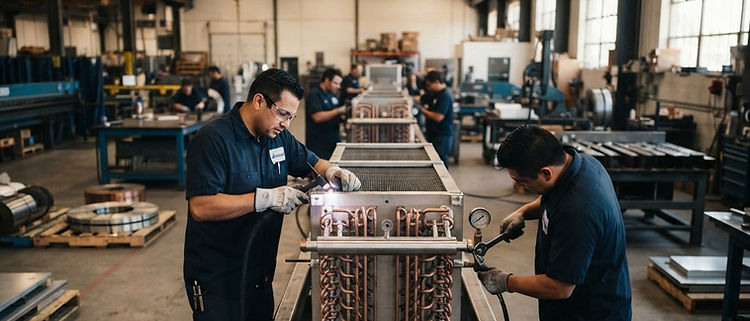
Committed to yearly production increases, a heat transfer equipment maker doubted it could deliver. USC redesigned the floor plan, consolidated two shifts into one and brought parts to the line, lifting output with fewer staff.
Results
20%
increase in units a day, from 136 to 164, now on one shift instead of two
18%
reduction in labor to sales for unit coolers
18%
reduction in labor to sales for Minicon units
Daily output rose after consolidating two shifts into one.
The situation
The company had committed to year-over-year production increases but doubted it could meet them.
What the assessment found
- Disconnected floor layout causing long material moves
- Fabrication areas not connected to the main line
- Assembly workers leaving the line to retrieve parts
- Silo-style management slow to confront obstacles
How the work was done
Layout: connect the floor
Quantified waste and true capacity cell by cell, then built a new floor plan that tied fabrication to the main line.
Crewing: one shift, more output
Consolidated two shifts into one, using capacity analysis and the knowledge of experienced employees to remove redundant work.
20%
increase in units a day
Parts: keep them on the line
Introduced a kanban system so every needed part was at the line, and short interval control to confront obstacles quickly.
Before and after
Units per day
+20%
Labor to sales, unit coolers
−1.6 pts
Efficiency, unit coolers
+24.1 pts
Labor to sales, Minicon
−1.1 pts
Labor to sales and efficiency are percentages; units are per day.
Lasting impact
The manufacturer extended the approach across the rest of the plant and adopted USC's way of weighing effort against reward, with cross-functional action to meet its production commitments.
Related case studies
Manufacturing
Control systems maker adds $1.5M annual revenue, cuts labor cost per job 51%
$1.5Mincrease in annual revenue
Read the case study →Manufacturing
Pulp and paper maker cuts bleach chemical costs $2M a year at one mill
$2Min annual bleach chemical savings at one mill
Read the case study →Manufacturing
PE firm's manufacturing holding cuts $6M a year and creates $36M in value
$6Min annualized cost savings
Read the case study →